
 Yazar


When we first heard the name Richard Gadd through Baby Reindeer, it was clear he hadn’t merely created a successful mini-series — he had announced himself as one of television’s new and original voices. That production, which left its award season rivals with little to stand on, drew attention for its ability to transform personal trauma into narrative. Now, after an interval, Gadd returns with Half Man, and once again chooses to wander the dark corridors of the human soul. This time, however, his focus is less on obsessive fixation or victimhood, and more on the destruction wrought by suppressed identities and desires that cannot be spoken aloud.
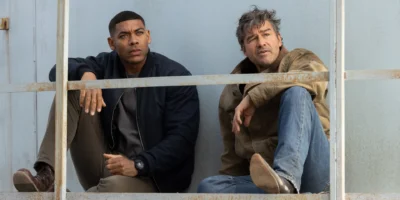
The series centers on an extraordinarily complex relationship between a man forced to conceal his sexual orientation under the weight of homophobic pressure, and the stepbrother who harbors a tangled mixture of deep admiration, desire, and rage toward him. What initially appears to be a story of toxic brotherhood transforms, as the episodes progress, into a far more layered psychological examination through the lenses of addiction, obsession, power dynamics, and the need for belonging. At times, the nature of their relationship even generates an unsettling tension that oscillates between platonic fixation and BDSM aesthetics.

Portrait of an Anti-Villain
The character of Niall, brought to life by Jamie Bell, is one of the series’ most striking elements — because his fundamental motivation is not hatred, but repressed desire. His intense attachment to his stepbrother becomes an invisible center that determines every decision he makes throughout his life. When his stepbrother is present, the character can transform into a creative, productive, and successful person; in his absence, he devolves into a fiasco machine that battles addiction and systematically sabotages his own life. And so he places the blame for every failure he suffers squarely on his stepbrother’s shoulders.
One of the most fascinating aspects of Half Man emerges precisely here: what creates the tragedy in the series is not outright malice, but truths that cannot be confessed. The character’s inability to acknowledge his homosexual identity even to himself generates a pressure that builds over years. Every crisis, every outburst of violence, every act of destruction that follows becomes a byproduct of this repression. Gadd‘s screenplay chooses to observe the psychological dead ends his characters inhabit, rather than passing judgment on them.

The Stepbrother as a Source of Chaos
The stepbrother character played by Richard Gadd himself is one of the series’ biggest surprises — and Gadd was not willing to let this role go to anyone else. He underwent a physical transformation to play Ruben, shedding every trace of his Baby Reindeer self and adopting an entirely different persona. What initially reads as a classic school bully grows, as the episodes unfold, into a far more complex human being. Shaped by childhood traumas, his rage occasionally turns him into an uncontrolled figure who damages everything around him. Yet his vitality, energy, and magnetic ability to draw people in his wake cause the viewer to oscillate in the distance they maintain from him.
This is why the character defies familiar anti-hero templates. We’re accustomed to anti-heroes on television; but Half Man‘s achievement lies in placing an anti-villain at its center. Because Ruben often appears to be the person resolving the story’s problems, while simultaneously being the most dangerous element driving those problems to grow. The viewer finds themselves agreeing with him for a moment, then, minutes later, watching him become a psychopath they struggle to empathize with. This dual structure keeps the series’ tension perpetually alive.
The choice to make the character intellectually weak yet instinctively powerful is also significant. His tendency to react rather than analyze, to act rather than think, means the story is constantly on the verge of spinning out of control. The tension in the series thus isn’t merely about what will happen next — it grows from the uncertainty of how far this character might go.

A History of the Unspoken
The most successful quality of Half Man is that it refuses to present this whole web of relationships as merely an individual tragedy. A family raised by lesbian mothers theoretically creates a space open to confession. And yet the characters’ inability to express themselves shows just how deeply social pressure can reach. The series situates Glasgow’s conservative milieu in its backdrop, positioning homophobia not as a threat that exists only in the outside world, but as an invisible prison lodged inside the human mind.
This is why at the story’s center lies not physical violence so much as a psychological silence. The things the characters cannot say produce greater consequences than the things they can. The structure woven together through flashbacks reinforces this idea. Through the connections built between past and present, the viewer comes to see that the catastrophes unfolding are the result of repressed emotions that have accumulated over years. The confrontation scenes standing as the series’ most gut-wrenching moments conveys viscerally why this narrative has been constructed with such force.
The choice to have the main character narrate the story in the finale by returning from the point where he has made peace with his own identity is, in this sense, a meaningful one. Because Half Man is not, at its core, a story of redemption — it stays in the memory as a confrontation narrative that tries to understand why redemption came so late.

Richard Gadd’s New Triumph
Taken all together, Half Man transcends the role of a mini-series about the relationship between two troubled characters. It becomes a powerful character study that investigates what kinds of fractures social pressure creates in the human psyche, how repressed desires can transform into violence, and how thin the line between love and obsession truly is.
Richard Gadd proves once again that the success he earned after Baby Reindeer is no fluke. Through its sense of dread stretched across a long time span, its paranoid atmosphere, and its layered character writing, Half Man creates a compelling viewing experience that keeps its audience hooked through to the final episode. The reason each episode flows so effortlessly is rooted in exactly this: the story advances through silences growing inside the characters — silences that are always interesting to observe.
That is why Half Man is not only one of the year’s best mini-series, but also one of those productions that reminds us how powerful a narrative tool television can still be when it comes to examining the human soul. That we will be hearing Richard Gadd‘s name far more frequently in the years to come is a certainty. If the award season is open to surprises, Half Man taking home a host of awards — just like Baby Reindeer — will come as no surprise to anyone.
To read more articles by Haktan Kaan İçel, click here.
Follow us on Youtube, X, and Instagram for more.


Yorumlar