
 Yazar
Yazar 


The Odyssey is the story of those who, on this earth where humanity has existed for hundreds of thousands of years, have rowed against merciless waves. It is the tale of those who carry today’s nature from the past, who notice the foam of the waves spilling into the boat only after reaching the shore, and who can lend a direct ear to the shrillness of the sirens. Christopher Nolan gives a 2,800-year-old text a state-of-the-art appearance through a reformist lens. He kindles an epic fire on the silver screen about the impossibility of consuming grief. As this fireball glides toward us, those walking among the plundered and the slaughtered are consumed as they feel the heat of this timeless fire that has not gone out for thousands of years. Today’s trace lies, in this world, along an ancient line stretching from the pains of the past toward the future. King Odysseus’s journey home to Ithaca sits directly at the edge of that line. The belonging and faith of his waiting wife Penelope and his son Telemachus are an old likeness that humanity has carved onto its horizon for centuries.
Christopher Nolan returns with The Odyssey following Oppenheimer, for which he won the Academy Award. Adapted from the Greek epic of the same name by Homer, one of the most celebrated names in ancient Greek literature, the film is arguably the most epic and fantastical work in the director’s filmography. The Odyssey, which opens in Turkish theaters on July 17, features a cast of notable names including Matt Damon, Tom Holland, Anne Hathaway, Robert Pattinson, Jon Bernthal, Zendaya, and Charlize Theron. The film’s score is once again composed by Ludwig Göransson, following Tenet and Oppenheimer.
The Odyssey is an epic feast in which the conflicts, inner journeys, and all the suffering that have persisted throughout human history are painted with fantastical elements and lavish sequences, while its editing opens up entirely new doors. Alongside the mythological creatures and the lives sacrificed, another thing being rowed toward is what is left behind. The unreached and the uncaught are also the enchanted desires standing at the end of where the current began. Just as the narrative opens with a story, the core reason this oral epic has survived to our day is really how we get swept up in the tale. Christopher Nolan is well aware of this. The Odyssey is a potpourri directed at the movement of confrontation between the past, the present, and things that no longer exist. Having a home, and being able to return to it, is still every mortal’s first wish. In this world, the Law of Zeus exists for everyone. Regardless of who tells it, how we want to hear it, or what we understand from it, what we hear has been just as shared and just as ours for centuries.
This article may contain spoilers about The Odyssey.
Losing While Winning
In this realm we find ourselves in, even the seas, the islands, and the winds we take shelter in each time are uncertain. This holds true both while being cooped up inside a horse for days during the Trojan War, and while setting off for home after winning that war. In the equation where a gain costs more than it earns, the crew occupies the numerator, while the denominator is forever full of obstacles. In this story, which unfolds around the curse of a one-eyed giant named Cyclops who isn’t particularly gifted at reasoning, first the Trojans and then Poseidon emerge as the visible arbiters of this curse. Fantastical elements such as the sirens — described as half-bird, half-woman creatures who lure sailors with their songs — or the sorceress Circe, who can turn an entire crew into pigs, are various mines hidden along the road home.
Whether the army can escape these traps is determined by how collectively it can hold together during the grueling journey. The individual and identity-based disintegration of this 108-strong army of warriors is depicted through the stages of the journey. Circe, for instance, strips down the bodies of these greedy men who see their own bulk as a weapon. Likewise, Cyclops, from a more dominant position, makes the crew feel like ants. Through these hidden traps, Nolan presents adventure, entertainment, and darkness in good balance. The sirens’ voice comes to represent not just an uncontrolled feeling of madness and desire, but Odysseus’s defiance against all of reality. But what if what is presented to us as reality in the universe we’re watching is actually the weight of the character’s past and his decisions?
Odysseus, in order to return home, finds himself in the middle of a decade-long trial unfolding piece by piece. The gods have various games planned for him. This time, they are the enraged party. While his wife waits for him, the suitors are on the verge of seizing the entire palace. Antinous, who wants to gain control of Ithaca, is pursuing marriage with Queen Penelope. Odysseus, meanwhile, struggles to remain in existence through bloody adventures while trapped in the limbo between death and truth. As the might of the gods takes the stage, the road home only grows harder. Athena’s guidance is a symbol, for Odysseus, of both anger and remembrance. Calypso, whom he encounters afterward, first heals his body with lotus flowers, then makes him forget his past — that is, she dulls his mind. For Odysseus wants to overcome the people he has lost by numbing his past and forgetting them, if only briefly. Poseidon, meanwhile, hurls his curse toward every realm through the seas’ wild waves.
Odysseus comes to realize, over time, that the ambitions at the core of the war and the journey were wrong. Agamemnon’s army has won a victory, but here, a gain is always followed by those who are lost. Everything begins with the arrogance of an arrow fired at the sleeping, massive Cyclops. Death and life have an encounter in the wake of those who are lost — just as when chasing the setting sun into the sea on the horizon. This encounter is the uncaught voice of all the other devastations caused by the destruction wrought by the Trojan War.

On the Intersection Between the Text and the Director
Christopher Nolan, after winning the Academy Award he had long been awaited to win thanks to Oppenheimer, comes before us with The Odyssey, a production close to his own cinema yet just as different. It draws its pace not from the speed of time, but from the power the story it tells holds over its sequences. The narrative intersects across separate perspectives in different timeframes. The present-day story arc is presented quite seamlessly as it carries traces of the past into today. The fantastical side of the text, meanwhile, catches a different rhythm in this respect alongside Nolan‘s lavish cinema.
The authenticity of the source text, which has been adapted to the seventh art in different ways for centuries, undoubtedly creates many opportunities for the audience to feel a sense of familiarity with the director. However, this relationship of closeness is used in The Odyssey as a step layered out of the comfort zone. Christopher Nolan sifts the elements that have been clichés repeated for centuries in the original text through concepts he magnifies from his own perspective. The abstract sides concerning death, sacrifice, alienation, justice, memory, and belonging merge with all the concrete elements through the director’s cinematic power and the text’s timeless effectiveness. The most striking thing here is the harmony between Nolan‘s trademark ability to “create powerful and striking moments per sequence” and the epic, mystical narrative of The Odyssey.
The Odyssey, through the power of its sound, editing, art direction, music, and direction, can almost make us forget a text we had already memorized. It can set apart a work that is one of cinema’s cornerstones. For their fifth collaboration, Nolan works once again with Hoyte van Hoytema on cinematography. Aware that what he is constructing is an adaptation, the director gently shakes off the dust left in the corners. Through the Law of Zeus, he touches on the deconstructions of both today and the past. He places it at the foundation as the text’s central point of inquiry.
By splitting the story into many branches through different perspectives, the director makes use of the inclusiveness of Homer‘s epic. In doing so, he lowers his camera to the crew’s shoulder and hurls the sea’s sweeping power right at our faces. Amid the rowing oars, we witness a breathtaking experience alongside the crew. There is a directorial approach here that tries to minimize the distance between the audience and the characters. After all, the characters’ loneliness in the universe is frequently emphasized through wide shots. Most of the objects and attachments present in the screenplay grow throughout the journey. By the time we reach resolution, each of these elements comes into its own distinct power.

The Cost of Rekindling the Ashes
Another reason behind the kings who started the Trojan War is that humanity has been searching for an excuse for war for centuries. Nolan offers a narrative about what the desire to burn, destroy, plunder, and annihilate actually corresponds to. This war that begins is for the sake of someone else’s birth. Throughout his life, Odysseus has taken on the role of “destroyer” at the kings’ behest. He has devoted his life to conquering and establishing power. His army slaughters the Trojans by the end of the campaign, but he himself gets lost right there, in the midst of his own crew. The pace of his pounding heart is in projection with the ruins falling around him and the screams he hears. For this disappearance lies between the side that caused the suffering and the difficulty of taking refuge in that suffering. He is aware that he must now find his own way. The trace he leaves on the ground he treads is not his own, but the traces of someone who resembles him. From that moment on, every journey he takes means someone else’s disappearance. The monsters that cement this disappearance become the visible silhouettes of the violence spreading across the entire planet in an atmosphere where the Law of Zeus has been disregarded. They are no different from the reflection of every human being cast upon the water.
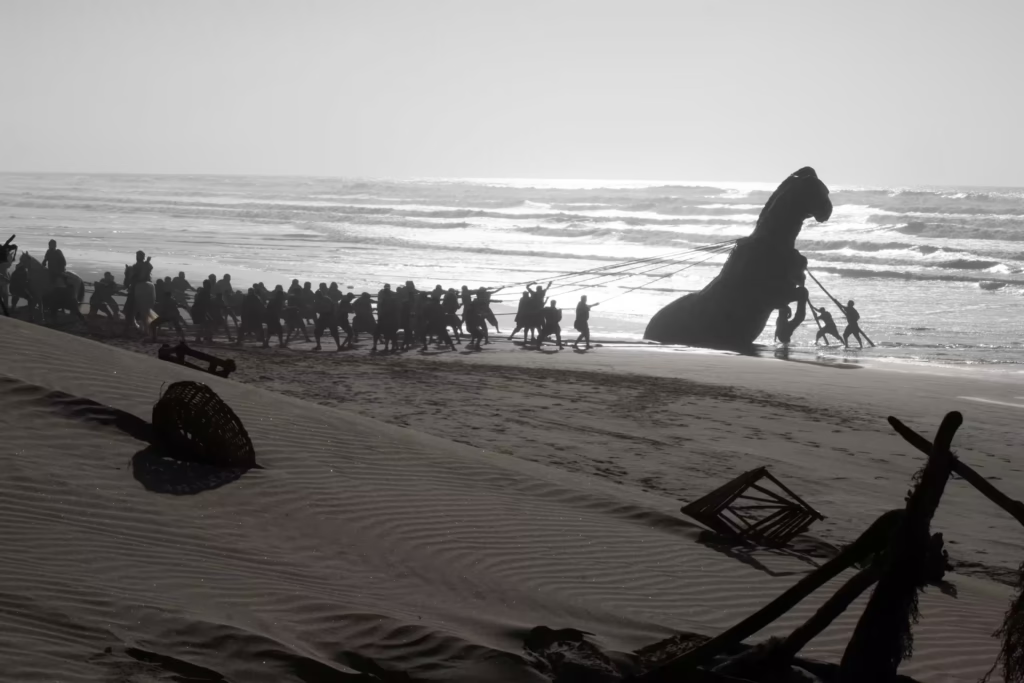
Nolan makes a statement directed at the present day through how the elements that unite humanity, the social contracts, are lost pointlessly, for whatever ambitions, and through whatever lies. He places his camera’s focus on the burning Trojan Horse. The sacred bond between host and guest has been violated, transgressed. The real issue is not conquering a fortress from without or within. It is, rather, how good intentions catch fire in the face of evil ambitions. Because kindling a fire is far too easy. Fire is one of humanity’s most primitive aids, one of its weapons. The ash-like relationships of societies are also a result of this mental arming. With every life lost, piles of ash spill from the ground. From that scene onward, they accumulate in Odysseus’s pockets. As time goes on, they grow heavier, becoming impossible to carry. What’s more, these are not the pockets of any ordinary garment. They are shelters for a need that falls from a person’s very self, one that his shadow carries on its back.
The fact that the statue of Athena, who guides Odysseus, is that of a Trojan slaughtered before it is a direct depiction of this moral collapse. Athena looks at Odysseus every time with anger and as if demanding accountability. However much Odysseus may want to forget the past, Athena’s presence is there to remind him of it. For someone who can truly see the truths can remember that they have hidden all the ashes within their own shadow. To be able to see, one must first notice, and then remember. King Odysseus continues slowly on his path. Over time, he first looks ahead, and then at what kind of trace he leaves on the ground. When he notices his shadow, there is another reckoning awaiting those who become aware of its reflection.
The moral and ethical weight of The Odyssey becomes even clearer in one further scene, within the framework of the death theme. This is the Land of the Dead (Hades) sequence. Nolan designs the setting as a dark, hazy island reminiscent of the apocalypse. The pinkness of the sky and the hazy blue of the horizon face off against the dullness of the earth. The deep sound design and heavy use of music, meanwhile, heighten the sense of the unknown while helping convey the island’s darkness. Spirits are summoned through offerings, accompanied by blood rituals. Odysseus comes to this island with his army to find Tiresias, but instead encounters Sinon, the young soldier who sacrificed himself before the Trojan Horse. Anger, desperation, and regret can be read on the young soldier’s face in this scene. Sinon cries out to him that he was deceived by lies and abandoned to death. Agamemnon’s ghost, meanwhile, has been betrayed by his wife Clytemnestra. He tells Odysseus that returning home is not the only right path. The scene helps Odysseus learn certain prophecies and truths, while becoming the character’s first deep confrontation on his journey. Odysseus, who has no idea how his crew will get home, is chased toward his ship by the thousands who have lost their lives.

Weapons of Mass Destruction That Unite the Centuries
It wouldn’t be too far off to say that, specifically in his last two films, Christopher Nolan has been chasing after the grand mass weapons that divide communities. Along these lines, it’s striking how the depiction of the weapon that turns home and guest to ash via the Trojan Horse resembles the atomic bomb in Oppenheimer. There is a mutual resemblance between the moral burden Odysseus struggles to carry and the moral dilemma Robert Oppenheimer experiences with the doomsday bomb he creates. What these two different eras have in common is that a magnificent horse offered as a gift turns into a weapon that leads to the slaughter of an entire people, and that this — in a different form — repeats itself centuries later as a scientific catastrophe. Behind Odysseus’s annihilation of a people and Robert Oppenheimer‘s invention of the bomb lie the same lifeless bodies of the same innocent people.
In both films, the director attempts to objectify whatever will give rise to savagery and cram it within the frame. In terms of the space it occupies in the narrative, this use recalls the monolith scene in Stanley Kubrick‘s unforgettable work 2001: A Space Odyssey (1968). The rising sound in the sequences where the Trojan Horse looms is almost as if trying to scream out the timeless tragedies that humanity’s mind has created. Much like the music rising toward a shriek-like pitch as the monolith appears in 2001: A Space Odyssey. In addition, we could say that the short-term memory loss Calypso creates with her lotus flowers also recalls, in terms of its manipulation of time, the director’s other film Memento (2000).
What Christopher Nolan does with The Odyssey sets itself apart within his own body of work through its mystical, fantastical, and grotesque sides. It’s possible to say that this atmosphere evokes various similarities to certain directors. At times, without shying away from being frightening, the director wants to reflect the tense and unknowable texture of the era. Within this framework, he is able to create unsettling sequences reminiscent of Robert Eggers‘s dreamlike realism. The nightmarish renderings gain texture through our unfamiliarity with mystical monsters. Even so, Nolan doesn’t treat the monsters as one-dimensional. To the Cyclops above all, he adds a perspective similar to Guillermo del Toro‘s sincere and layered approach. The design of the Cyclops, meanwhile, recalls the famous Spanish painter Goya‘s painting Saturn Devouring His Son. On the other hand, the sequence in which the Trojan Horse is collectively carried by the Trojans recalls — in terms of its use of crowd scenes — Andrei Tarkovsky‘s film Andrei Rublev (1966). It captures a similar feeling to that film in the way it etches all the mud and grime of the era onto the screen. Just as in The Last Temptation of Christ (1988), a film that was pregnant with controversy in the period it was released, Martin Scorsese‘s film, The Odyssey too carries a morally flawed human perspective through an iconic figure. If we look at it from a body-horror perspective, the scene in which the crew is turned into pigs in Circe’s home brings to mind the playful approach to bodily transformation of David Cronenberg, one of the genre’s forerunners.
In short, it already seems certain that The Odyssey will leave its mark on this awards season. Nolan, who amplifies his technical achievements with the demands of an epic and mythological story, gives the audience a distinct viewing experience through sound design, music, editing, and cinematography. Matt Damon, an actor we’ve frequently encountered before in Nolan‘s cinema, succeeds in conveying the grief, pain, and all the emotions of his demanding role through close-ups. He manages to amplify his physical performance in line with the expectations of epic cinema. The performances of Anne Hathaway, John Leguizamo, and Elliot Page are among the other standout elements.
Christopher Nolan, through The Odyssey, ensures that humanity’s similar sufferings echo once again in shared equations. On this journey, returning home is not about taking shelter under a roof, but about managing not to be crushed under the immovable weight of conscience. The Odyssey is a familiar voice screamed at us from the past; a reminder that, unfortunately, the ink with which today’s sufferings are continuously being written never runs dry.
Click here to read more articles by Ahmet Duvan.
You can follow us on Youtube, X, and Instagram for more.







Yorumlar