
 Yazar
Yazar 


Natalie Erika James’s third feature, the 2026 film Saccharine, may superficially belong to the body-horror genre, yet it offers a philosophical narrative that draws us into the struggle between the devastation caused by contemporary ideals of beauty, the self and illusion.
Australian writer-director James, as in Apartment 7A and Relic, uses horror to reveal through a feminist subtext the strangeness that accompanies desire. By engaging with cultural anxieties around eating disorders and body image, Saccharine signals from its opening credits that it will take a different path from The Substance, whose influence is nevertheless clear. With clever references to popular weight-loss drugs such as Ozempic and Mounjaro, Saccharine builds a supernatural atmosphere of satire around the way thinness is imposed as though it were a moral virtue.

A Grotesque Expression of Desire and Disgust
The film opens with highly aggressive audiovisual methods of depicting body positivity. Close-ups of characters rapidly consuming sweets and junk food, paired with the pale colour palette of these scenes, create a nightmarish air. Hana (Midori Francis), aware that the pursuit of the ideal body intersects with exercise and sport, appears trapped in an inescapable cycle.
Hana, who experiences compulsive binge-eating episodes, is a medical student struggling with body-image issues and a deeply controlling mother. Shame about her appearance has led her to live a largely isolated life. Bombarded on social media with messages about body positivity and dieting, she joins the campus gym and unknowingly takes the first step into a new life. She is put through a strict diet and exercise programme, with trainer Alanya (Madeleine Madden) monitoring her progress. Yet this ordinary, controlled process—partly because of Hana’s attraction to Alanya—is never enough, and she researches rapid weight-loss methods to capture her trainer’s attention.
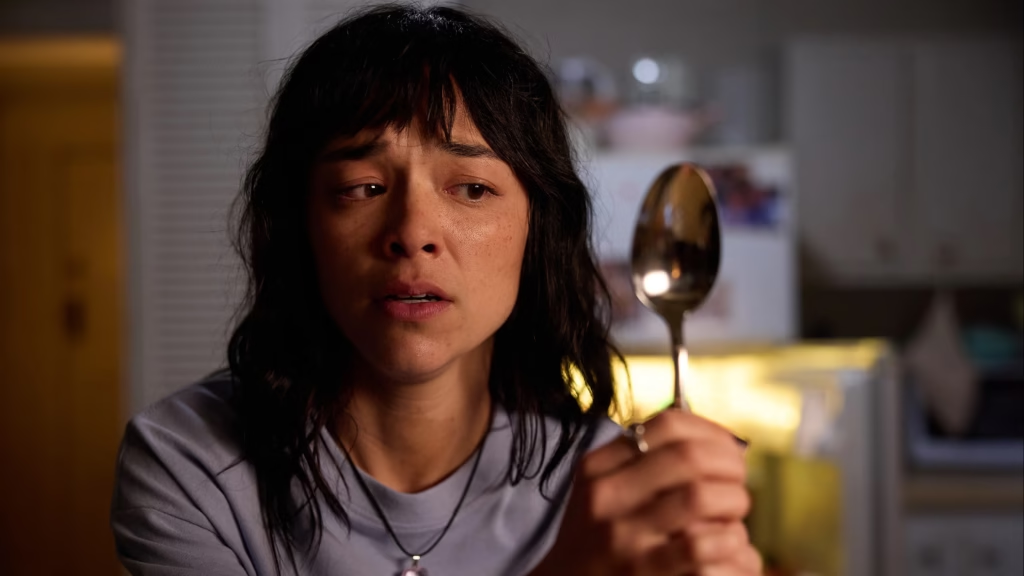
A friend who was once very overweight but is now extremely thin recommends an unreleased diet pill. Far beyond the means of a low-income student, the pills fascinate Hana. She obtains a single tablet and studies its ingredients in the university laboratory after class. When the supposed diet pill turns out to contain “human remains and ashes,” Hana does not hesitate to make a bargain with the devil in order to produce her own. She goes so far as to steal pieces from a cadaver examined in anatomy class and manufacture pills from its bones.
A Ghost Rebelling Against Modern Diet Culture
The cadaver, whose real name is Grace and who is called “Big Bertha” in class, initially seems to bring Hana good fortune. But as Hana begins losing weight at a shocking pace, events cease to follow her plan and she falls under the curse of the experiment she believed would save her. Bertha’s enormous, swollen and decaying body attaches itself to Hana, haunting her like a ghost in mirrors and other convex surfaces. The more Hana eats, the more weight she loses, causing Bertha to become increasingly aggressive and terrorise her life.
The film also shows that Hana’s eating disorder has roots in her family. Her father is portrayed only sitting at home in the dark, a figure whose fatness is a source of family shame. The indirect messages her Japanese mother (Showko Showfukutei) gives Hana about her weight reinforce her body dysmorphia. Her mother’s tale from Buddhist folklore about a suffering, insatiable hungry ghost also maps directly onto Bertha. Even so, several people around Hana remind her that her place and worth in the world are not determined by her body, ensuring that the film does not abandon its affirming message.
The Chronic Process of Self-Denial
Midori Francis gives an impressive performance as Hana moves through complex and unstable emotional states. The film’s mounting anxiety is reinforced by electronic music and the sound of breathing. Deliberately exaggerated, sticky sounds in the eating scenes create an especially powerful sense of disgust. It is also clear that the extremely fat bodies in the film are designed to frighten the viewer, with Big Bertha as the most striking example. Like the enraged entity in It Follows (2014), Big Bertha succeeds in turning Hana’s life into a nightmare.
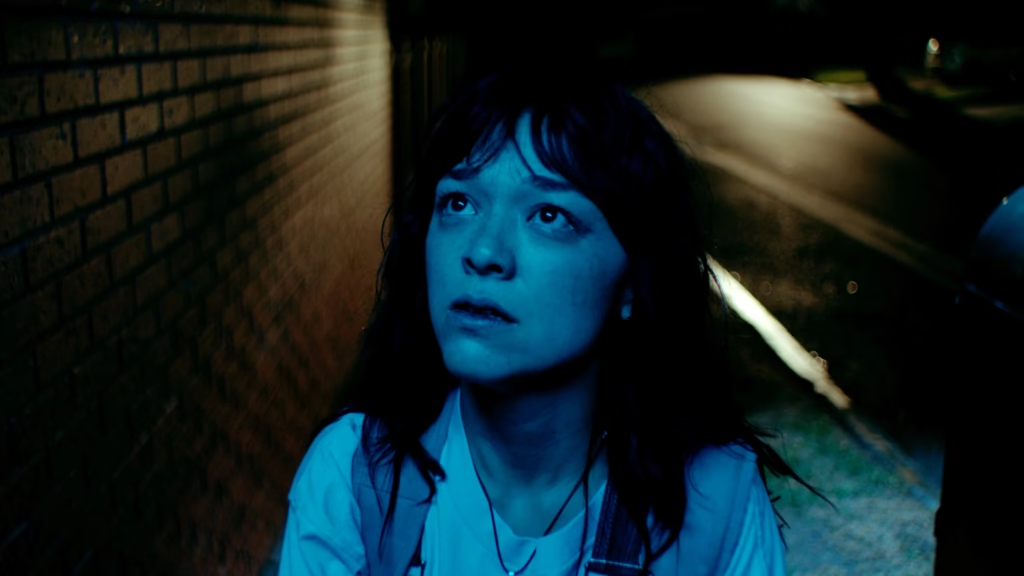
Director James’s commitment to the tradition of “post-traumatic psychological horror” is intensified by Hana’s hallucinations of sleeping among rubbish. In the sequence where Hana’s perception of her body disappears completely, her position beneath heaps of waste evokes the absolute lowest point. After this, the total collapse of her already fragile self-image leads to repeated cycles of striking intensity and revulsion.
The wax Anatomical Venus created by sculptor Susini, seen in many scenes of Saccharine, reflects Hana’s obsession with the body. These wax models take the form of sleeping, nude, beautiful women whose internal organs can be removed and replaced, giving them a metaphorical role. Through this figure, the film suggests that true and divine perfection is possible only in death. In the finale, Hana kills the idealised Alanya to reach ultimate perfection and removes her organs like an Anatomical Venus, confronting us with the disturbing nature of our obsession with body image.
Apart from several inconsistencies in its screenplay, Saccharine is filled with cinematographer Charlie Sarroff’s sensory surprises and deserves praise within its genre. By approaching a timely and powerful subject almost entirely from a female perspective, with scarcely any male characters, it has a distinctive sensitivity. Treating the struggle with self-image in a vulnerable register, the film places diet culture at its centre. As viewers, we too feel as though we are descending into an ever-deepening nightmare alongside a character who has never learned to be kind to herself.
Click here to read more articles by Fatma Kıpçak.
For more, follow us on YouTube, X and Instagram.



Yorumlar