
 Yazar


Family easily tops the list of the worst things that can happen to us. Breaking ties with relatives you don’t love requires lengthy struggle. But worse still is that your closest relatives — your siblings, for instance — can hurt you without batting an eye. They steal from you when you refuse to lend them money, acting without regard for how those left behind will manage. Rather than working and striving to reach the life they dreamed of, they leave others in desperate straits so they themselves can take the easy path to comfort. This picture will be familiar to most of us.
Shame and Money focuses on the struggle of a large Kosovar family living in the countryside after a crisis befalls them. A mother, her three sons, their wives, and grandchildren are scraping by. The youngest son, Liridon (Tristan Halilaj), finds a way to ask his mother for two thousand euros. He asks Hatixhe (Flonja Kodheli), his brother’s wife, to help him. But Hatixhe and Shaban (Astrit Kabashi), who make ends meet through livestock farming and selling milk, barely have enough for themselves.
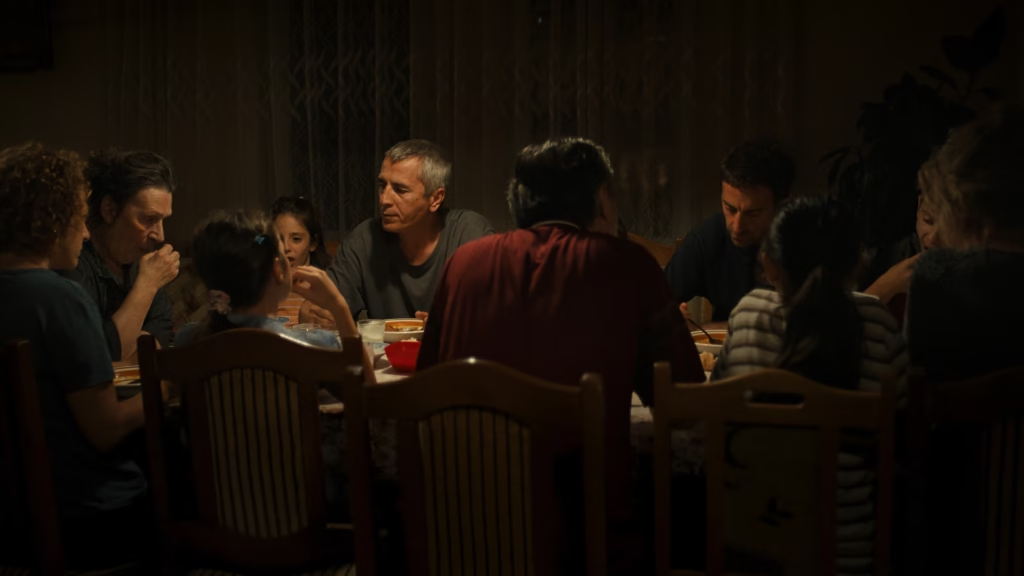
Liridon voices his request at the dinner table, even with no one supporting him. But after the argument that follows, he leaves the table with his pride wounded. A few days later, Shaban and Hatixhe find themselves with an empty barn, and understand they’ve been completely swindled. Stripped of the animals that made survival possible in the countryside, the family heads to Pristina in hopes of finding work. Suppressing the silent rage born of their desperation, they try to adapt to the big city — only to quickly discover that getting bread out of the lion’s mouth is not as easy as it seemed, leaving them more hopeless than ever about their uncertain future.
Kosovar director Visar Morina‘s third feature, Shame and Money, processes its characters’ predicaments through the lens of class. Saying what it has to say without raising its voice, in a quietly affecting manner, the film premiered at the 48th Sundance Film Festival. Competing in the “World Cinema Dramatic” category, Shame and Money won the award and drew significant attention. Its first Turkish screening was held at Sinematek/Sinemaevi as part of the Kino 2026 selection.
Every Man for Himself
Shame and Money separates real and latent power dynamics within the first twenty minutes. Liridon believes that no matter what, his mother will give him the money he wants. But during the dinner table argument, his faith is shaken when the eldest brother raises his voice. The eldest brother — a teacher — tells Liridon that he knows exactly how much his salary is, because he has stolen from him countless times. This truth, thrown openly in his face, raises the tension between the two while also introducing the characters to the viewer.
Liridon tells his brother he doesn’t want to raise his hand against him in front of the family. But the brother doesn’t hesitate — he stands up and slaps Liridon. This scene shows the viewer that whoever holds the money holds the power. Their mother, immediately after Liridon leaves the table, asks her eldest son to go and apologize. But the brother, who holds the power, chooses to maintain his dominance. He remains indifferent throughout the process that leads to the cattle being stolen. His steady income makes him impervious to the anxieties of others.
On the other hand, we encounter other characters who maintain their silence until things touch their own interests. In the capital, they are welcomed by Hatixhe’s sister Nana (Kumrije Hoxha). Nana’s husband Alban (Alban Ukaj), who runs a club, is also content thanks to his class superiority. Though the sisters support each other, the relationship between the brothers-in-law quickly becomes strained. Alban, who gives Shaban work at the club that doesn’t even count as part-time, ignores Shaban’s job search. Shaban resorts to looking for work on the street.
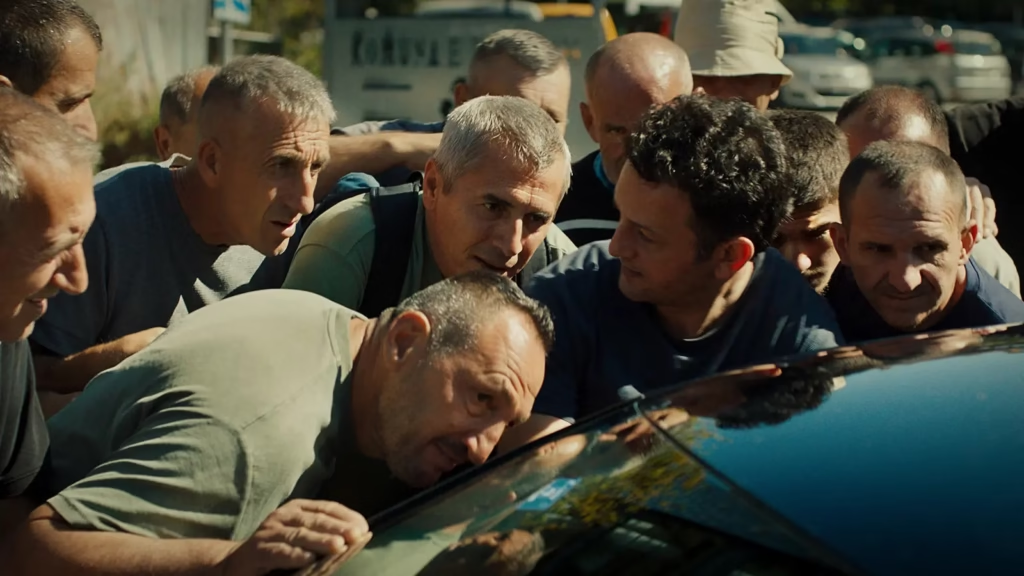
And so Shaban begins looking for work in a place like a labor market — doing odd jobs: carrying loads, garden work, small repairs. It frustrates him that hours of labor earn just ten or fifteen euros, but he cannot afford to be choosy. Then Alban hears from an acquaintance that Shaban is looking for work on the streets. Uncomfortable, he tries to intercept Shaban, offering him more than he could earn at the work in question to get him off the streets. Alban, who had treated his brother-in-law’s livelihood struggles as a trivial matter until his own reputation was at stake, acts with the same selfishness as the eldest brother.

Her Shame is His Luxury
Meanwhile, when Hatixhe arrives in Pristina, she reunites with her sister Nana. Nana’s life, which seemed alluring from a distance, loses its magic the more Hatixhe enters that world. Because Nana, who is forced to care for her bedridden father-in-law, calls on Hatixhe for help repeatedly as she cannot lift him herself. The source of their affluent lives seems to be this bedridden man who falls, vomits, soils himself. Nana donates her invisible labor in exchange for this high standard of living. She is less a daughter-in-law than the household’s servant. The injection Nana gives herself reveals the possibility of IVF treatment — as if her position in that house would be strengthened if they had children.
Nana tells Hatixhe plainly that her husband is ashamed because Shaban is looking for work on the street. Hatixhe replies that shame is a luxury they cannot afford. She knows this, even as she and Shaban become a couple who speak less and less. When they first arrive in Pristina, they are asked for another month’s rent on the apartment they’ve taken. Shaban’s mother gives her last piece of gold. Shaban and Hatixhe, feeling a deep pang of conscience, look for ways to take it back. But when Shaban brings the money, he learns the landlord has already sold the gold. The silent rage that Shaban has not directed at his brother or at Alban finally finds its target here. His insistence, which escalates into a violation of the home, ends up leaving them homeless — trapping them in what they tell themselves is temporary accommodation in Alban’s cabin.
Shaban harbors resentment toward the man who takes him to his house to fix fences. His emotion wants to break free from where it’s been suppressed. People who hold power — like his brother, Alban, and the landlord — not only remind him of his powerlessness but also expose his helplessness. Even when he is the first to raise his hand and strike, he ends up on the receiving end of a beating by the day’s end. This is exactly how the wheels of capitalism turn. Shame and Money almost counsels Shaban — a man who counts even shame as a luxury, who has no right to choose his work or fight for his rights — not to clash with the system. When he can buy his daughter shoes for her birthday, hope stirs. Perhaps it is precisely through this that Shaban learns to transform his silent rage. While his aggression finds life in his dreams, in his waking hours he becomes the “reasonable citizen.”
The Threat Hidden Inside Hope
Shame and Money points to the fact that even people who have hit absolute rock bottom are forced to put in their labor despite having no safety net. The days when Shaban returns home empty-handed after working for hours confirm this anxiety. The scene where he tries to recover the gold from the landlord in particular recalls Saeed Roustayi‘s Leila’s Brothers. Both films convey shared themes — masculinity, reputation, power, money, and shame — through the specific lens of their own geographies. In contrast to Leila’s efforts to hold the family together, the mother-in-law criticizes Hatixhe for not looking after her children. Helping Nana earns Hatixhe no money while causing her to neglect her children. As the time to enroll the children in school approaches, this realization created by the mother-in-law reminds the audience of the necessity of finding other paths.
The invisible silent rage of the underclass creates a sense of entrapment in the viewer too. That same rage, and everything that happens throughout the process, points to where hope exists. The terrible order that once again requires working for the rich is presented under the guise of hope. Like a snake eating its own tail, hope turns into hopelessness, and from there — under the logic of “something is better than nothing” — into a feeble consolation. In short, Shame and Money, despite the tension it creates in the viewer, may easily get lost among other films on similar subjects due to its muted manner.
To read more articles by Burcu Demirer, click here.
Follow us on Youtube, X, and Instagram for more.




Yorumlar