
 Yazar


A young couple named Tyler and Maddie sets out on a life in their RV, and one night, driving down a deserted highway, they witness a horrifying accident. When they leave the crash behind, they’ll realize that a supernatural entity from the accident has latched onto them. This supernatural being, called The Passenger, is a demon that cannot be escaped — one that begins relentlessly pursuing them both in order to consume them.
Passenger is a supernatural horror film directed by Norwegian filmmaker André Øvredal, with a screenplay by Zachary Donohue and T.W. Burgess. In the producer’s chair sit Walter Hamada, the former president of DC Films at Warner Bros., and Gary Dauberman, known for productions like The Nun and Annabelle Comes Home. The lead roles are filled by Jacob Scipio (Bad Boys: Ride or Die) as Tyler, Lou Llobell (Foundation) as Maddie, and Melissa Leo as Diana. Filming took place in early 2025 in Washington State, USA — notably, real RV owners participated as extras for the caravan scenes around Enumclaw Expo Center and the Grand Coulee area. The film opens directly on May 22, 2026 in the US and worldwide with no festival premiere.
Director André Øvredal first drew attention with the Norwegian-language Troll Hunter (2010), then moved to Hollywood, where he made The Autopsy of Jane Doe (2016), Scary Stories to Tell in the Dark (2019) produced by Guillermo del Toro, and The Last Voyage of the Demeter (2023), adapted from Bram Stoker‘s Dracula. His description of this film as “the scariest film he’s ever made” in an interview with Bloody Disgusting is, unfortunately, a claim that doesn’t hold up when you look at the results.
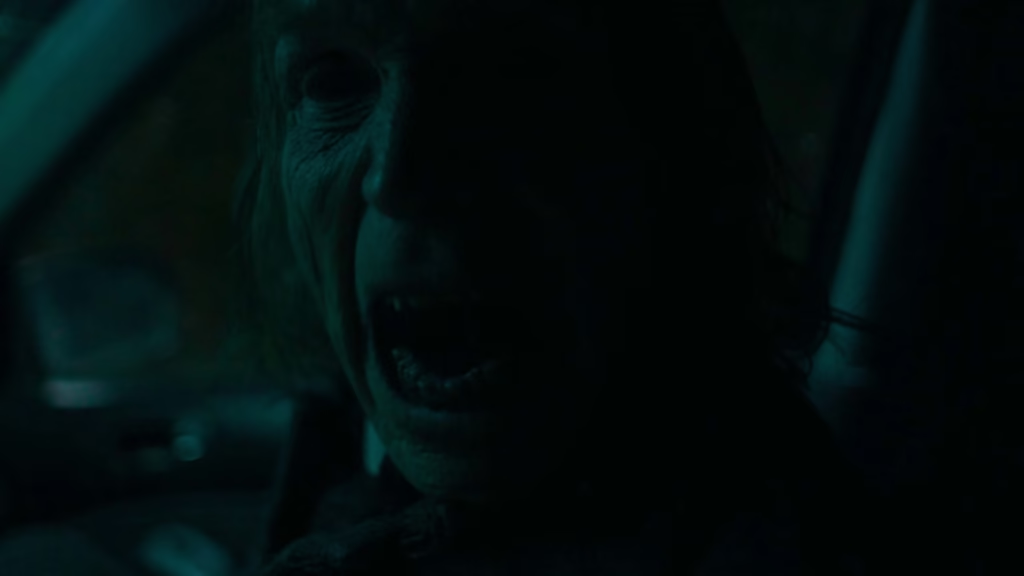
A Pile of Jumpscares and Clichés
While Passenger‘s concept is intriguing, the film doesn’t stay confined to roads and vehicles as one might expect. Øvredal is normally known for his mastery in concentrating dread within a single, restricted space — a morgue in The Autopsy of Jane Doe, a ship in The Last Voyage of the Demeter. Here, though he uses the idea of a cursed road and could theoretically squeeze the action onto a single road and vehicle, he fragments the film across multiple locations and days, destroying the expected atmosphere. The characters are thrown from a motel room to a restaurant, then to a festival grounds, then to a mountaintop in the Arizona desert. This constantly requires the film to re-establish its rhythm, and it undermines from the outset the claustrophobic atmosphere that road horror could have generated. Critics have already described the film as one that possesses an interesting atmosphere, creative scenes, and two compelling lead performances — yet is a prisoner of a screenplay that never fully resolves its mythology and thematic direction.
The horror in the film leans heavily on jumpscare sequences. While many of these are technically well-constructed, they remain overly predictable and grow stale after a while. The film as a whole falls below what one would expect from a director like Øvredal — it creates the feeling of a first film by a new director. While the lack of recognizable faces in the cast is a bonus for a horror film, the characters’ dialogue and behavior feel excessively cheap and weak. Throughout the film, a pile of well-worn clichés is served up at every turn. This approach — which could be read as a nod to road horror classics like The Hitcher, Joy Ride, and Jeepers Creepers — unfortunately never approaches the mastery those films achieve within their own frameworks. The film feels as though it was made by Øvredal under duress. The director’s signature appears almost exclusively in the visual language and in the use of prosthetic makeup in a handful of scenes.
It’s also clear that little thought went into the demon character’s design. The Passenger, brought to life by Joseph Lopez, is depicted as an entity that wanders in a priest’s disguise and appears before its victims with a terrifying grin — but its visual design feels extremely familiar. What we get is an elderly, long-haired male archetype reminiscent of the one in The Conjuring: Last Rites. This well-known design weakens the unease that should be the demon’s primary power. While the Saint Christopher mythology the film introduces stands out as an interesting idea, because the screenplay never develops this mythology with sufficient depth, most of the scenes related to it hang in the air. Moreover, the mythology being constantly explained through bluntly expository dialogue — shown rather than conveyed — once again exposes the weakness in the film’s screenplay.

Music and Cinematography: What Keeps the Film Alive
Despite all these shortcomings, Passenger manages to rise above average on the strength of its music and cinematography alone. The score composed by Christopher Young feels like the work of a master composer who knows exactly how to deploy silence and tension. Federico Verardi‘s cinematography stands out as the film’s true savior — particularly his mastery of light use is satisfying. Much of the film is lit by limited sources: the deep darkness of night, ring roads illuminated by headlights, the pale glow of parking lot lamps, and the flickering projection beam of a cinema. Verardi uses darkness meaningfully while always ensuring the viewer can follow the mise-en-scène clearly. That said, it’s already evident that the darkness in many of the film’s scenes will be invisible in theaters with poor projection.
Passenger remains the weakest link in Øvredal‘s filmography. A director who showed in The Autopsy of Jane Doe and The Last Voyage of the Demeter how to concentrate fear in confined spaces, here loses his strong concept the moment he takes it out onto the open road. The density of clichés, weak character writing, a predictable pile of jumpscares, and a generic demon design reduce the film to one of the genre’s average productions. While Christopher Young‘s atmospheric score and the visual language Federico Verardi constructs spare the film from being a complete disappointment, it’s also clear that this is not work befitting Øvredal. The director’s words about making “the scariest film he’s ever made” unfortunately find no answer in the results, and Passenger fails to rise above a mediocre weekend genre fright.
To read more articles by Buğra Mert Alkayalar, click here.
Follow us on Youtube, X, and Instagram for more.
Kill Bill: The Whole Bloody Affair: A Bloody Symphony in One Piece



Yorumlar