
 Yazar


Star Wars: The Mandalorian and Grogu arrives as a 2026 Star Wars film directed by Marvel heavyweight Jon Favreau, co-written with Dave Filoni and Noah Kloor. The film is a continuation of The Mandalorian series, which aired for three seasons on Disney+ from 2019 to 2023, and opens in cinemas on May 22, 2026 as a Lucasfilm production distributed by Disney.
Pedro Pascal, who plays Din Djarin, is joined by Jeremy Allen White as Rotta the Hutt and the legendary Sigourney Weaver as the new character Colonel Ward. The project carries additional significance as the first Star Wars film in seven years, since The Rise of Skywalker.
Favreau had already written the scripts for the fourth season of the series, but says that following the 2023 Hollywood strikes, Lucasfilm decided to make a theatrical film rather than a new season. The Mandalorian and Grogu also holds the distinction of being the lowest-budget Star Wars film of the Disney era — a piece of information that goes some way toward explaining the visual weaknesses felt while watching it.
The Empire has fallen, and the New Republic is trying to establish a new order. During this chaotic period of recovery, Mandalorian Din Djarin and his apprentice Grogu are working to track down what remains of the Empire one by one. One of their missions is the rescue of Rotta from the Hutt clan — a mission that will drag them into a new and dangerous adventure in the far reaches of the galaxy.

A TV Episode Crammed onto the Big Screen
The Mandalorian and Grogu feels less like a film and more like watching 2–3 episodes of a new season of The Mandalorian back to back. Yet even so, it can’t manage to be as gripping or as successful as the series — the result is something utterly bland. It would have felt much more appropriate released as an exclusive Disney+ film. Characters go from Point A to Point B, gather intelligence, move on to Point C — and this cycle repeats throughout the film. Favreau has, quite literally, stretched a routine mission we’d recognize from the series’ filler episodes into a 2-hour-12-minute film.
There is no proper script, flow, or character arc to speak of. Almost none of the characters undergo any meaningful change over the course of the film; their motivations remain superficial. None of the villains or adversaries stand out or manage to pull the audience in. The absence of character development causes the film to play out as nothing but a chain of missions, making it nearly impossible to form an emotional connection.
Then there’s the seemingly endless finale. The film’s problems with flow and pacing inevitably carry over into the ending as well. For its entire final half hour, The Mandalorian and Grogu keeps creating the feeling that it’s about to wrap up — and then doesn’t. It drags on and on, ultimately ending with a mediocre finale. This further diminishes the story’s already weak impact and leaves audiences walking out of the theater unsatisfied.
On the other hand, Grogu is as adorable as ever and does manage to win the audience’s heart — though he remains nearly the film’s only redeeming quality. Grogu, born from the combination of animatronic puppetry and visual effects, appears far more on screen in this film than he did in the series and is pushed to the forefront as an important part of the mission.
Pedro Pascal‘s Din Djarin is already a character whose face is mostly hidden behind the visor of his helmet, and that tendency continues in the film — the character wanders around as an almost passive hero. Sigourney Weaver‘s Colonel Ward, despite the actress’s charisma, can’t transcend the limited material the script offers her. Jeremy Allen White‘s voice performance as Gladiator Rotta the Hutt fails to impress — the character is one of those rendered with poor CGI. Veteran director Martin Scorsese, meanwhile, surprises everyone with a small, unexpected cameo in the film.
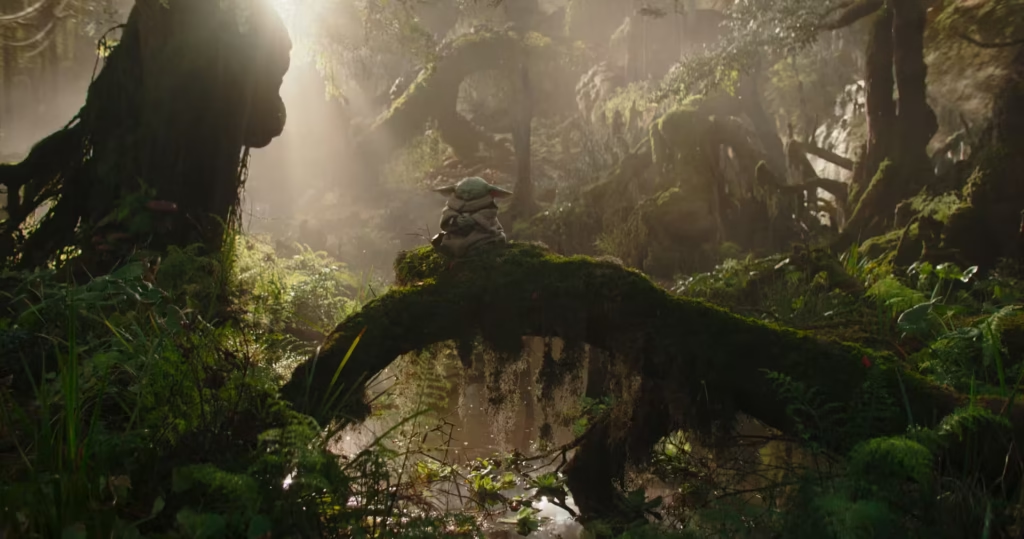
Disney’s Inexplicable CGI Problem
Disney houses Industrial Light & Magic (ILM), the film industry’s most established and successful visual effects company. Founded in 1975 by George Lucas for Star Wars and acquired by Disney in 2012, ILM is the industry’s most decorated VFX company — with 15 Best Visual Effects Oscars — bearing its signature on countless legendary productions from the Star Wars franchise to Jurassic Park, from Pirates of the Caribbean to Avengers.
Moreover, StageCraft (The Volume) — the signature technology that became the hallmark of The Mandalorian series — is itself an ILM innovation. Despite all of this, the CGI in the film is conspicuously poor and deeply uncomfortable to watch. Many of the CGI characters and certain scenes are presented at a level of failure that you simply wouldn’t expect from this production. The action scenes in the film look like CGI monsters clashing into each other, like toy figures being smashed together.
This problem is not unique to The Mandalorian and Grogu — it’s a headache that has plagued many of Disney’s major productions in recent years, especially the Marvel Cinematic Universe. For example, the scene in Black Widow where Yelena is hurled and flung from a helicopter motor practically screams “green screen”; Thor: Love and Thunder and Doctor Strange in the Multiverse of Madness contain similar issues; and practically all of Ant-Man and the Wasp: Quantumania was a CGI catastrophe.
Behind this problem lie institutional failings — VFX artists being forced to work excessively long hours and resources being distributed unfairly between projects. The CGI shortcomings in The Mandalorian and Grogu feel like part of this larger picture. The fact that the film was shot in California and kept on a tight budget goes some way toward explaining the deficiency — but doesn’t make it acceptable for a studio that houses a giant like ILM. This both undermines the film’s visual ambition and risks being read as a disrespect toward the practical effects legacy of the Star Wars universe.
The Mandalorian and Grogu has no great ambitions to begin with, and it’s abundantly clear that it’s a fan-service film — yet despite that, it takes its place in the canon as a bad enough Star Wars film to disappoint even those with no expectations at all. While the relentless action and colorful characters might satisfy some, they don’t create the potential to save the film. In the end, The Mandalorian and Grogu — emerging as the lowest-budget Star Wars production of the Disney era — is a project that would perhaps have been received far better had it remained an average episode of the series. Its only apparent reason for being moved to the big screen is to make more money.
While Grogu’s cuteness and Ludwig Göransson‘s score stand out as the film’s only genuine highlights, everything else unfortunately proves that seven years after its last cinematic outing, Star Wars deserves better than this. Even those who kept their expectations low — or had none at all — should brace themselves. For Grogu’s sake, perhaps one last time… but this is not the way.
To read more articles by Buğra Mert Alkayalar, click here.
Follow us on Youtube, X, and Instagram for more.
Kill Bill: The Whole Bloody Affair: A Bloody Symphony in One Piece




Yorumlar