
 Yazar


Many people we pass by on the street carry unknown talents, unrealized potential, and dreams they tried but couldn’t see through. What stops them is not a lack of talent but a lack of time — the conditions of life that, once you take one path, make you forget the others. That’s why persisting in fields like art or sports, which demand great effort but offer little reward, is so hard. The enthusiasm of youth gives way, inevitably, to despair as the years pass.
Instruments, drawing pencils, writing drafts, and sports careers often end in injury — all are condemned to the corridors of the past. Besides, no one can endure constantly remembering such disappointments. That’s why ignoring the bitterness of unrealized possibilities helps one heal. Acceptance becomes the key word. The growing acceptance that something will never be deflects the “I never really wanted it anyway.” Sooner or later, one learns to be happy with the other path they chose — even if out of necessity.
Written and directed by Kent Jones, Late Fame had its world premiere in the Orizzonti section of the 50th Venice Film Festival. Produced by a team that includes notable names like Martin Scorsese, the film centers on a group of young people who discover a poet years after his time. Ed Saxburger (Willem Dafoe), who worked creatively in 1970s New York, leaves his talent and potential behind and begins working at a post office. The armor of forgetting envelops him more and more.
Fifty years later, the sudden appearance of a young man claiming to have been looking for him on his street reawakens desires buried deep in the past. His dead dreams return to life. As the young people’s admiration surrounds Ed, he gives himself over to the glow of late-arriving fame. Like any artist who never fully used their potential, Ed leaves behind the fear of dying undiscovered. But is Ed ready to face the expectations that come with fame? Could anyone be ready for that?

Carrying the Past into the Present
Nostalgia means “a longing for home.” In modern times, its meaning becomes distorted — both “home” and “the feeling of longing” drift from their original meanings. We recall the past with wistfulness, knowing we can’t return to it, and take refuge in a generalized form of protection. Nostalgia takes hold of us. Even the names we give to generations show that we live looking backward. From fashion to music, from lifestyle to economics, we always look with envy at the periods before our own — an era, for instance, when technology had not yet dominated our lives.
Since returning to the past is impossible, we bring the past into the present — push-button phones, or an artist who couldn’t shine in their time and is hungry for attention. Both, transferred to today, serve to resurrect a dead era. Spaces also accompany this desire, of course. The choice of a city like New York — always reinventing itself — as the backdrop for Late Fame stands out as a conscious decision.
The way the group calling themselves the Enthusiasm Society exists is consistent with this approach. Like characters in old sitcoms, they always go to the same café and debate what they’ve written. The power dynamics among them shift easily. Only Meyers (Edmund Donovan), who leads the group, maintains his authority. Everyone else treats his words as law and his wishes as commandments. Voices that dare to criticize are as few as they are dismissed.
Ed Saxburger, played by Willem Dafoe — who elevates every project he joins — goes to one of the group’s meetings at Meyers’s invitation. Over time, he realizes that the group is mostly made up of wealthy children, Meyers included. The class dimension of being able to freely pursue art confronts him. Ed Saxburger finds himself caught between the excitement of being rediscovered and the group’s twisted dynamics. The poet, whose poems had once been published, now realizes he can no longer write when the young people ask him for new poems. Idolized by them, he faces the reality of mediocrity for the first time.

Escape from Reality
Late Fame, rather than using its political potential, treats its subject with a minimal approach. After a while, all scenes focusing on Ed’s relationship with the group emerge as a choice that is as shallow as it is simple. The few moments he spends alone pass quickly. For example, a voice on his answering machine tells Ed that a relative is in the hospital. A little later it turns out to be his brother. Yet the audience never learns why Ed doesn’t go to the hospital. Ed ignores the matter — as if dismissing not his brother but how close death is. He attends the Enthusiasm Society’s invitation without question. Nearly more than fame, feeling young again seems to matter.
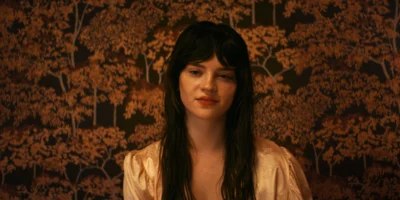
Ed comes alive especially when he meets Gloria, the group’s only female member. Gloria (Greta Lee), who is an actress, quickly draws Ed to her. Positioned like a femme fatale, Gloria acts on instinct. She attracts the men in the group. With her aura and talent, all eyes are always on her. She resembles a clown who entertains and makes everyone laugh but suffers alone when no one is watching.
Ed visits her at home but cannot understand the dilemma she is in. The sequence that offers intuitive answers about how a young woman survives in New York eventually loses its power. It easily turns into an artist’s crisis. Most of the time, what defines us is not what we actually feel or who we are, but how others perceive us. In that sense, Gloria is the locomotive character who says “the show must go on.”

The Weight of Losing Yourself
Ed Saxburger’s youth coincides with the 1960s and 1970s. During that period, reactions against the mainstream rise, and counterculture forms in response to major events like the Vietnam War. Where the Enthusiasm Society criticizes people who are happier with influencers and virtual personas, it points more toward imitation than genuine counterculture. Today’s artificiality takes shape through past practices and gains a sense of authenticity. They even plan an old-fashioned poetry reading night, but then find that selling tickets is not as easy as they’d imagined. This is the moment they pick up their phones and start calling acquaintances — meaning the supposed stance they built against their society’s reality crumbles. The false reality inevitably collapses.
Late Fame finally says what it wants to say openly. One of the younger, more clear-headed members of the group asks Ed Saxburger to read what he has written. His attitude implies that the entire future of his life and artistic career depends on Ed’s feedback. The character’s fragile artist vulnerability transforms with Ed’s words: “You shouldn’t put your self-worth on a tray and offer it to an old man.” Ed’s wavering and anxieties throughout Late Fame dissolve after these words leave his mouth.
By nature, every artist wants to be liked, seen, appreciated. On the other hand, none of these desires are worth the weight of a life sustained by measuring your self-confidence with someone else’s words. In my view, the film ends by leaving Ed exactly where it aimed. Perhaps what it wants to say is that what is truly frightening is not dying undiscovered, but losing yourself in the pursuit of fame. This 96-minute parenthesis opened on being an artist closes with the same simplicity. The viewer is left with that familiar joy of watching Willem Dafoe.
For more of Burcu Demirer‘s writing, click here.
Follow us on Youtube, X and Instagram for more.




Yorumlar