
 Yazar


Mother Mary, a global pop icon, knocks on the door of her closest friend and former costume designer Sam Anselm — a woman she hasn’t spoken to in a decade — on the eve of her comeback concert. What begins as a request for a dress gradually surfaces wounds buried beneath the surface, and the supernatural bond between the two women transforms into a spiritually charged encounter woven with tension.
Distributed by Başka Sinema, Mother Mary opened in cinemas on April 17, 2026. The film is written and directed by David Lowery, known for pushing the boundaries of genre with films as varied as A Ghost Story (2017), The Old Man & the Gun (2018), and The Green Knight (2021). With Mother Mary, he goes to the furthest extreme of his eclectic filmography. The film stars Anne Hathaway and Michaela Coel, with Hunter Schafer, Atheena Frizzell, FKA Twigs, and Kaia Gerber completing the cast. Music is contributed by Jack Antonoff, Charli XCX, and FKA Twigs, while the score is composed by Lowery’s longtime collaborator Daniel Hart. Mother Mary had its Turkish premiere in the N Kolay Galas section of the 45th Istanbul Film Festival, opening in cinemas the same day.

A Pop Icon Modeled After Lady Gaga
The character of Mother Mary as played by Anne Hathaway — with her maximalist dance-pop music, postmodern exaggerated costumes, and provocative Catholic imagery that blurs the sacred and the sinful — feels like a direct copy modeled after Lady Gaga.
While the influence extends to Madonna, Beyoncé, and Taylor Swift, the Gaga connection seems the most dominant. The character’s stage shows accompany some genuinely powerful and striking scenes. In particular, the scene where Mother Mary rehearses the choreography for her new single without music is one of the film’s most memorable moments. Hathaway hurling her body against the wooden floor — a dance performance morphing into something almost demonic — compellingly exposes the physical and emotional toll that pop stars hide behind the music.
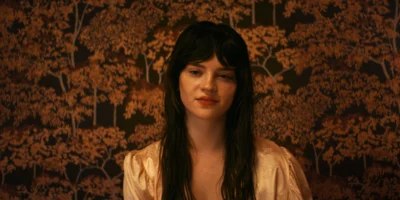
Michaela Coel is the film’s real surprise in the role of Sam Anselm. She delicately portrays Sam as a character who carries a quiet grief beneath a cold exterior and barely contained anger. The transitions in Coel’s facial expressions sometimes convey more than long monologues ever could. Lowery’s camera lingers on the two actors’ faces in long close-ups, especially bringing out Coel’s strength. Though both deliver powerful performances, these performances become lost within a story and a rhythm that won’t appeal to everyone.

A Film Held Captive by Metaphors and Dialogue
Nearly half the film takes place in a single location — a cold barn that serves as Sam’s workshop and home in the English countryside — through intense dialogue between the characters. Given that Lowery originally conceived this structure as an Off-Broadway play format, this choice seems understandable, but once translated to the cinema screen it risks alienating many viewers. The dialogue is often vague and deliberately abstract. What the two characters say to each other drifts into a metaphysical space rather than deepening the characters and enriching the story as they would in a conventional narrative. This seriously disrupts the film’s fluidity.
The film also advances in such an abstract and metaphor-laden way that it eventually leaves you alone with scenes indistinguishable from a dream. Lowery plays this card to the limit in Mother Mary, as he did in A Ghost Story and The Green Knight. The line delivered by Hathaway’s character at one point — “These metaphors are exhausting” — seems to capture the audience’s exact feeling. The film resembles Black Swan and The Neon Demon in its blending of the fantastic and the thriller, and is visually reminiscent of The Neon Demon as well. But unfortunately it cannot match their power or narrative coherence. The intense relationship between the characters disappears beneath an accumulation of metaphorical scenes.
Beneath the surface of Mother Mary, there is actually a deeply personal story. Mary and Sam are not merely professional partners — the film implies that they share a relationship close to love, hard to define but intensely felt. Sam is the creator of Mother Mary’s stage persona, but as Mary became famous she left Sam behind, moving on to other designers, and this separation is treated like the end of a romantic relationship.
The wounds that surface when Mary arrives at her door ten years later are embodied in the film as a supernatural entity — a red fabric / spirit. This red spirit becomes the metaphor for the pain the two women have left in each other, the trauma they shared, and the bond they cannot sever. After Sam sees the spirit the night she watches Mary’s final concert, she is freed from it — but the spirit passes to Mary and begins consuming her from within. What Lowery ultimately seems to want to communicate: the price of artistic creation, how fame swallows identity, and how the creative energy connecting two people can be both healing and destructive. But all of this is wrapped in such layered metaphors that what the film wants to say remains opaque for most viewers.

Religious References and Stylized Visuals
As its title suggests, Mother Mary is built on a story laden with religious allusions. The character’s stage name, her iconic status, and the tension between the sacred and the sinful form the thematic core of the film. This use of religion places the film in territory that will already unsettle conservative audiences. But Lowery’s way of deploying religious imagery is neither sufficiently provocative nor does it add sufficient depth. The idea of presenting pop stardom as a kind of secular sanctity is an interesting starting point, but the film prefers to skim the surface rather than develop this idea. The attempt to merge an exorcism narrative with pop-star drama is bold, but ultimately fails to do justice to either.
Outside of the performances, the film’s two greatest achievements are its stylized cinematography and its music. The cinematography by Andrew Droz Palermo and Rina Yang becomes one of the pillars supporting the film’s atmosphere. The controlled, almost sterile visual language of the early scenes evolves into a more unstable register as the film shifts toward the supernatural. At least visually and atmospherically it succeeds in delivering eye-catching frames. The musical contributions paint a more mixed picture. The songs by Jack Antonoff, Charli XCX, and FKA Twigs are functional in Mother Mary’s stage scenes, though some feel like polished but impersonal pieces designed to be hits that never quite become real ones.
Mother Mary emerges as the sharpest film in David Lowery‘s filmography. With this film, as with his others, he stamps his signature through fantasy elements and heavy dialogue — but here he goes much more intense and abstract. The powerful performances of Hathaway and Coel, the stylized visual language, and the atmospheric music are the film’s undeniable strengths. But the narrative crushed beneath metaphors, the tempo disrupted by the accumulation of dialogue, and the religious references that never deepen make the film a low-enjoyment experience. Mother Mary becomes one of the most debated films of the 45th Istanbul Film Festival — bold, but unbalanced.
For more of Buğra Mert Alkayalar‘s writing, click here.
Follow us on Youtube, X and Instagram for more.




Yorumlar