
 Yazar
Yazar 


A talented child growing up under his father’s pressure in a small industrial town in Indiana, a rising star in the group he performed in with his brothers, and a legend who stepped onto the world stage alone… Michael covers the early years of Michael Jackson‘s career, from his childhood to the peak of the Bad tour.
The director’s chair belongs to Antoine Fuqua, while the screenplay was written by John Logan. Fuqua is one of the experienced directors known for gritty, realistic films such as Training Day, Brooklyn’s Finest, and The Equalizer, while Logan is known for screenplays such as Gladiator, The Aviator, and Skyfall.
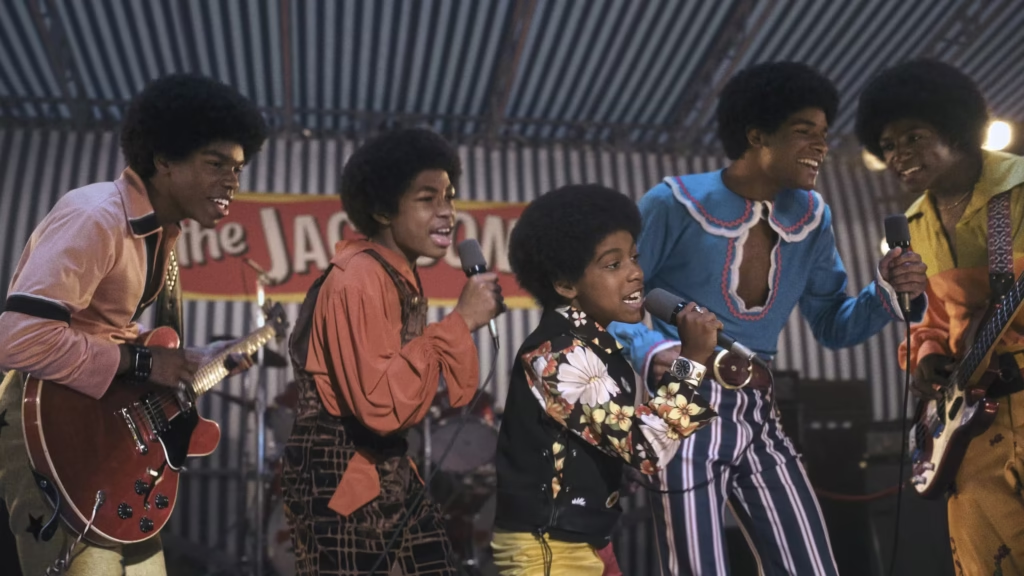
The actor who portrays Michael Jackson in his adult years is Jackson‘s own nephew, Jaafar Jackson, while the childhood role is taken on by Juliano Krue Valdi. The supporting cast includes names such as Colman Domingo, Nia Long, Miles Teller, Kendrick Sampson, and Mike Myers. The involvement of the Jackson family in the production of the film — distributed by Lionsgate Films — along with its filming being delayed due to the SAG-AFTRA strike and the reshooting of the third act from scratch in January 2025, appears to have affected the film in multiple ways.
Jaafar Jackson Shines Like a Star
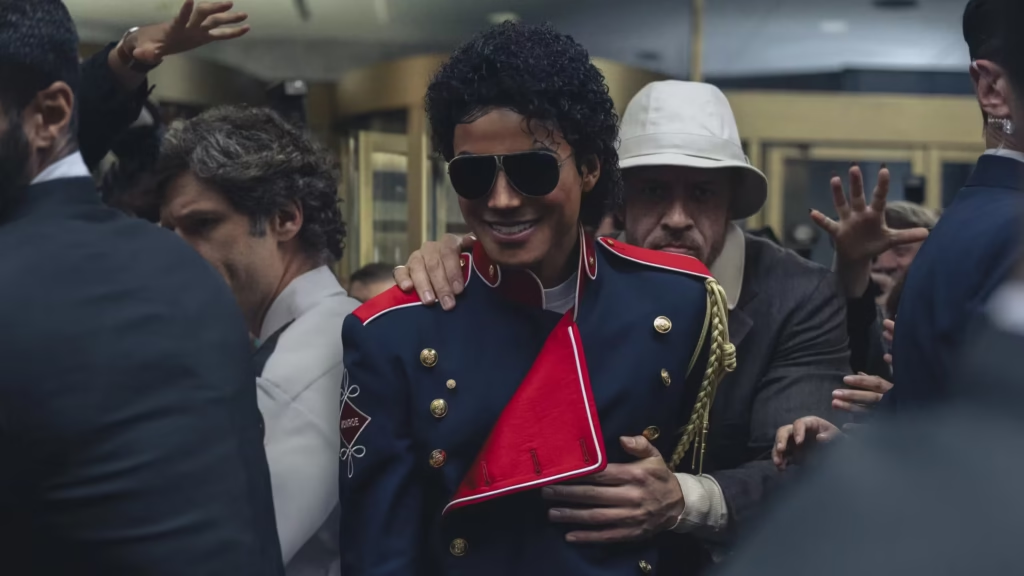
The film’s uncontested star is Jaafar Jackson. The young actor, tasked with portraying his uncle, transforms into Michael Jackson without falling into the imitation trap. His voice, posture, the legendary dance moves, and that distinctive bearing poised between fragility and sharpness all appear to have been successfully internalized. Jaafar Jackson pulls off a risky and courageous role and launches his acting career with an ambitious statement. Opposite him, Colman Domingo portrays Joe Jackson in the role of the repulsive, authoritarian, and manipulative father in an impressive manner.
These two performances become the primary elements that lend the film its strength. However, the rest of the cast is left in the shadow of these two powerful performances centered on Michael and his father. Miles Teller‘s role as John Branca, or Kendrick Sampson‘s portrayal of Quincy Jones, are pushed to the background without being able to draw on the dramatic potential of the characters sufficiently. The sincere presence of Juliano Krue Valdi in the role of young Michael adds a certain authenticity to the first half of the film; however, this warmth gradually diminishes as the film progresses.
An Ordinary and Soulless Narrative
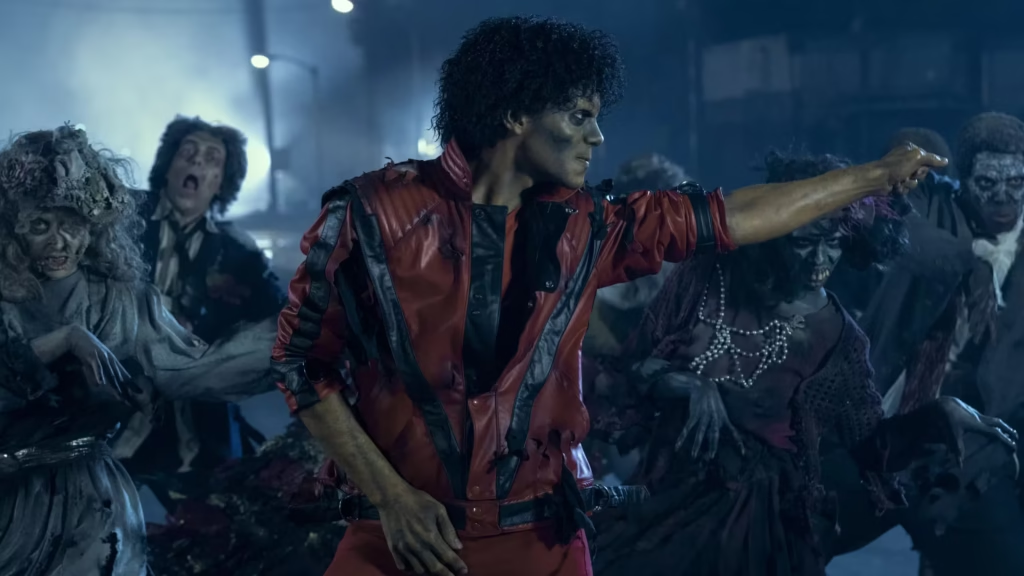
Technically, there is nothing to fault in Michael. The cinematography is clean, the production design successfully captures the period atmosphere of 1970s and 1980s America, and the costumes meticulously reconstruct Michael‘s iconic stage outfits. The concert scenes are spectacular, the dance sequences are painstakingly edited, and the sound design is enriched with remastered original recordings drawn from the Jackson legacy. In particular, the Human Nature, Billie Jean, and Bad performances offer genuinely impressive audiovisual moments.
The problem here is that in a film made with such a high budget and bearing the approval of the Jackson legacy, this level of technical quality already creates a baseline expectation. That is, the visual quality the film delivers is not so much an admirable achievement as it is a natural outcome of the genre and the production scale. For this reason, the successes in camera work, lighting, and costume design are not sufficient to paper over the film’s shortcomings — on the contrary, they only make it more apparent just how weak the narrative is that such powerful production values are serving.
The film’s weakness and central problem stems from the ordinariness of its storytelling. Michael repeats, wholesale, the formula we have seen countless times in the many musical biographical films of the past twenty years. Advancing with an episodic structure that lines up years and turning points one after another, the film tries to load every scene with “an important moment” while genuinely penetrating none of them. While the characters keep reminding each other in motivational speeches just how special Michael is, the audience already knows and accepts this reality from the film’s first minutes. The sharp, inquisitive, and distinctive directorial approach Fuqua shows in his crime dramas is nowhere to be felt; here he is directing as if filling an administrative role, present in name only.
The film’s other structural problem is its ending. Michael concludes precisely at the point where it is about to reach the real dramatic core — the transformation in Jackson‘s career and personality. Although it announces a sequel with the text “The story continues…”, this proves only that the film is nothing more than a prologue or an appetizer. Alongside a marketing strategy focused on generating greater excitement for the next film, what is actually served up here is a dim and flavorless first installment. The genuinely dramatic material in Michael‘s life, the controversies he generated in the public eye, and the complex inner world of the artist are all saved for the second film.
A Sterilized Story That Sidesteps Controversy
The film presents a narrative that makes no contact whatsoever with the sexual abuse allegations surrounding Michael Jackson — a story constructed with the approval and involvement of the family. Fuqua‘s statement in his interview with The New Yorker ahead of the release, in which he said he was “not convinced” by the allegations, makes clear that the film’s approach represents an explicit positioning.
Setting aside the artistic evaluation of the film, this issue — to which critics have responded with characterizations of “sanitized” and “incomplete” — serves as a reminder that the ethical stance a biographical drama takes toward its subject cannot be ignored. Likewise, Jackson’s vitiligo — a significant turning point in his life — is passed over in the film with barely a mention. Yet this condition occupied a central place in the construction of the artist’s public image and bodily identity.
Despite all these shortcomings, Michael still manages to provide a satisfying experience for its fan base. Seeing and hearing the songs of one of the most influential figures in music history, Michael Jackson, on a big screen with high production values, creates a draw in and of itself. The enthusiasm fans feel in the cinema, tapping their feet during the Thriller and Beat It sequences, stems less from the film’s success than from the enduring power of Jackson‘s permanent cultural legacy.
What distinguishes the film from a docudrama documentary is largely Jaafar Jackson‘s performance and the visual splendor of the production. Beyond these, the film tells us nothing we didn’t already know about Jackson; it opens no new window into the inner world of his character, and it doesn’t genuinely interrogate the artist’s creative process. It offers no more than a Michael Jackson documentary could, and it does not question the conventions of its genre. Those expecting more will find that the film’s real story has been saved for the sequel, and will leave the cinema with a sense of incompleteness.
To read more articles by Buğra Mert Alkayalar, click here.
Follow us on Youtube, X, and Instagram for more.




Yorumlar