
 Yazar


Ian Tuason‘s feature directorial debut, Undertone, grabs viewers through one of their most primal and vulnerable senses — hearing — without drowning in visual spectacle or digital effects. The film features only two actors (one of them comatose and motionless for almost the entire runtime), confined within the boundaries of a single location, creating an almost claustrophobic effect.
The story advances through the character of Evy Babic, brought to life by lead actress Nina Kiri; it transforms the narrow frame of a podcast broadcast into a vast door opening onto the dark corridors of the human mind. Distributed by A24, the film holds much more beneath the surface of a “ghost story.” Undertone functions as an auditory collage of technological isolation, the weight of filial duty, and suppressed guilt. Tuason poses the question: “Are you more frightened by what you see, or by imagining what it is you’re hearing?”

Noise-Canceling Nightmare Design
Undertone is, as its title implies, a film that draws its power from the spaces between the lines and the gaps in the frequencies. The sound department under David Gertsman‘s leadership transforms an ordinary dripping faucet or a kettle’s whistle into nerve-shredding instruments of torture. The moments when Evy puts on her noise-canceling headphones constitute the film’s most tense sequences. In these moments, we too disconnect from the outside world alongside Evy, focusing solely on the voice of her podcast partner Justin (Adam DiMarco) and the unsettling audio recordings they are listening to. But this isolation stokes the feeling that something is moving in the dark void behind it. The viewer is left alone with a “deafening” vulnerability — the knowledge that Evy, because of her headphones, will be unable to hear a real threat coming from outside.
The sounds in the film are used not only to frighten but also to tell the story. The labored breathing coming from Evy’s mother’s room — like the rhythm of approaching death filling the entire house — gradually begins to interweave with the supernatural audio files. The 10 audio files listened to as part of the podcast format create a “found footage” aesthetic within the film — only this time we follow the sound, not the image. These recordings, containing a couple named Jessa and Mike’s sleep apnea and sleeptalking experiments, hypnotize the viewer with dark messages hidden inside innocent children’s songs like “London Bridge Is Falling Down.” Tuason, who skillfully uses sonic dominance over space, is very good at trapping the viewer inside that narrow, claustrophobic house and planting us in the chair right next to Evy.
One of the most striking aspects of this auditory experience is the handling of “auditory pareidolia” — the brain’s tendency to extract familiar words or patterns from complex, meaningless sounds. This is used in the film to manipulate both the characters and the audience. The messages heard (or imagined to be heard) when recordings are played in reverse push the viewer to question their own perception. Is there really a demon there, or is a guilt-ridden mind extracting meaning from chaos? This ambiguity keeps the first half of the film at the edge of a psychological thriller, and with sound design this prominently foregrounded, Undertone becomes, at a certain point, a thoroughly unsettling experience.

Setting, Isolated Characters, and Layered Guilt
The film never leaves the confines of Evy’s childhood home. This spatial restriction ceases to be the disadvantage of a low-budget production and becomes the story’s most powerful thematic element. Cinematographer Graham Beasley uses the corners of the house, its dim corridors, and especially the unsettling void behind Evy to constantly evoke in the viewer a sense of being “watched.” Evy is simultaneously caring for her dying mother and trying to maintain a digital connection with a friend on the other side of the world. This could actually be described as modern humanity’s condition of being “connected but alone.” All the figures in Evy’s life — her partner, her doctor, her colleague — exist only as voices. The only person physically present with her in her home is her mother, who can no longer speak and is no different from a living corpse.
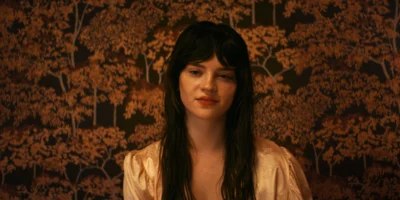
Nina Kiri‘s performance is the most crucial point in carrying the weight of this claustrophobic environment. With only her facial features and reactions, Kiri perfectly conveys to the viewer the emotional exhaustion of a caregiver and the anticipatory guilt that precedes grief. The question “I want it to be over now. Does that make me a bad person?” proves it comes from the darkest and most honest of human desires. Evy’s wish for her mother to die running in parallel with the supernatural events of the podcast turns the film into an examination of conscience. The Catholic iconography inside the house — especially the statue of St. Rita — functions as a visual seal, making Evy feel at every moment the weight of the faith she is trying to escape and her mother’s presumably judging gaze.
There is also a genuine cinematographic playground emerging from the location’s narrowness. The camera sometimes glides of its own accord — as if the house has a spirit — and at other times fixes on a void for longer than expected, unsettling the viewer. The constantly changing depth of field transforms even ordinary household objects into menacing figures. With no visual cues pointing to a life outside, we too come to believe that no world exists beyond these walls, that the entire universe consists of this uncanny two-storey house and the static coming through the headphones. This atmospheric achievement is the most important layer that allows the film to create an effect far larger than its budget.

Mythology, Symbolism, and Motherhood in Abyzou’s Darkness
The mystery at the film’s center draws on ancient Judeo-Christian mythology — the demon Abyzou, said to haunt children and pregnant women. This mythological choice is not coincidental; it connects directly to the film’s subtext of motherhood, pregnancy, and intergenerationally transmitted trauma. Evy’s revelation, as the film progresses, that she is pregnant — and her ambivalence about it — is a catalyst that raises the story’s tension level. The presence of Abyzou symbolizes both Evy’s “filial guilt” toward her own mother and the fear she feels toward her own potential motherhood. The messages revealed when children’s songs are played in reverse also prove how innocence can transform into horror.
Tuason, by deploying Catholic symbolism, underlines religion’s pressure on the individual and its function as an instrument of fear. The religious objects, crosses, and statues in the house serve not as a refuge for Evy but as eyes that constantly watch and judge her. The pressure experienced in particular by a woman expecting a child and a child caring for an elderly mother, when combined with the Abyzou legend, gives the film a theological subtext. But the film cannot always sustain this depth — because in the second half, the way this mythology is explained (Justin solving everything at once, for instance) is a problem that tarnishes the “minimalist mystery” of the film’s opening.
Still, the power of the symbolism becomes interesting again in the final scenes. The prophetic drawings on the walls, flickering lights, and the “auditory collage” created by the sounds expose the viewer to a sensory overload. The themes of motherhood and fertility, combined with the destruction-themed lyrics of songs like “London Bridge,” place the thin line between the beginning and end of life (a dying mother and a new life forming) on an uncanny plane. In this respect, Undertone will also bring to mind Natalie Erika James‘s Relic — both films succeed in touching our hearts by presenting family tragedy wrapped in a supernatural guise.

Between Success and Collapse
Undertone, while a technically near-flawless and impressively ambitious debut feature, does not avoid falling victim to its own success at certain points. The tremendous tension built in the film’s first half risks collapsing into a “pile of genre clichés” in the second. Tuason‘s decision to add too many visual and auditory devices near the film’s end, rather than remaining minimalist, can sometimes break the spell. Because the supernatural elements becoming too visible is a flaw that can simplify the sophisticated fear created by the question marks in our minds.
Despite this, looking at the film as a whole, it is clear that Ian Tuason is a director who absolutely must be followed. Especially through his sound mixing and design, he shows how the audience can be manipulated using only their ears. This talent, combined with a “low budget but high creativity” ethos, produces one of the most original horror films of recent years. The film may have missed its chance at “perfection” with its somewhat “too familiar” finale, but thanks to the atmosphere it creates and Nina Kiri‘s powerful performance, it may compel you to listen to the sounds in your own home even after it ends.
In short, Undertone is a fresh new breath in modern horror — a genre whose quality has been climbing to new heights lately. A film that proves silence can be more frightening than the loudest sound, it reminds viewers to think twice before putting on their noise-canceling headphones. If you can overlook the genre clichés in the finale and the occasional logical gaps, you are in for an extraordinarily sincere, unsettling horror experience that will ring in your ears. It is especially recommended for a midnight viewing in your room, alone with your headphones. Noise-cancelers and silence have never felt so threatening.
To read more articles by Ferit Doğan, click here.
Follow us on Youtube, X and Instagram for more.



Yorumlar