
 Yazar


Backrooms — one of the most iconic “creepypasta” legends of internet culture, turned into a YouTube phenomenon in the hands of Kane Parsons — finally arrives as a feature-length theatrical experience under the A24 banner. While Backrooms cracks open the doors to an original universe with its strange, uncanny, and claustrophobic atmosphere, it falls painfully short of delivering the depth it promises on the other side. Its lumbering screenplay, cardboard characters, and a structure that lures the viewer in with curiosity only to forget about delivering excitement make Backrooms a glittering, potent, but ultimately soulless liminal horror exercise.

Yellow Wallpaper and the Aesthetics of a Constructed World
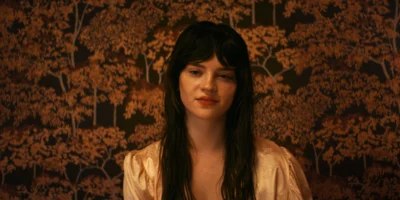
Let’s begin with what works, and what works well. The film’s undisputed greatest achievement lies in Kane Parsons‘s ability to translate the primal, analog dread he captured in his YouTube short series onto the big screen with an industrial aesthetic. Eye-catching set designs, humming fluorescent lights, and that suffocating “dirty yellow” color palette conjure the feeling of being trapped in an infinite Travelodge or a dystopia that is the polar opposite of Wes Anderson‘s cinema. In this respect, the film constructs an uncanny universe — colorful, sterile, and familiar at first glance, but revealed to be entirely artificial the deeper you go — in the vein of Ari Aster‘s Beau Is Afraid and Peter Weir‘s classic The Truman Show. The production design and sound mixing achieve such perfect harmony that as a viewer, you find yourself genuinely inside this unsettling geography.
The raw but intentional texture of the visual effects — clearly Blender-rendered in places — achieves a wonderful chemistry when combined with the music Kane Parsons himself composed. Rather than sticking out, the artificial digital roughness in certain scenes actually serves the universe’s nature by amplifying the film’s core feelings of simulation and entrapment, turning what could have been a flaw into a clever aesthetic choice. It feels as though the experimental spirit of 2000s indie science fiction and today’s digital game aesthetics and experiential sensibility have entered a magnificent marriage here. We share the claustrophobia of the characters wandering those ominous corridors ourselves.
This atmospheric achievement draws entirely from the collective memory buried deep in the internet. It all began with an uncanny “liminal space” photograph taken in an empty Wisconsin store in 2003 and posted on 4chan in 2019. Parsons, who saved this image to his computer when he was in eighth grade, knows how to translate the indescribable, strange feeling it created into a physical pressure tool in cinema. The dual perspective that comes from having a therapist for a mother and a visual effects artist for a father allows the director both to play in the dark corners of human psychology and to blend the raw found-footage quality of The Blair Witch Project with the labyrinthine unease of Mark Z. Danielewski‘s House of Leaves. But this world, rightfully celebrated in cinematographic terms, is not enough to keep the backbone of the story upright.

Mythology and World-Building Without Depth
When adapting an internet legend for the screen, the most critical threshold is how you bring the viewer into that world’s mythology. This vast universe — grown through the contributions of over 350,000 members in Reddit communities and internet wikis, cataloguing 100 different levels and hundreds of “entities” — is unfortunately not handled in the film with a proper world-building formula. World-building first requires opening a door at just the right angle; thought must be given to how that opening happens and how the viewer is invited into the process of discovery. Backrooms, however, while being highly ambitious about generating curiosity as it runs this process, completely forgets to deliver the excitement and organic satisfaction it promises in return.
Almost none of the scenes in which we should feel excited, tense, or desperately curious about what comes next manage to leave a real impression. The door to the universe does crack open, but once inside, you want more than just the claustrophobic effect — and the paths we could walk, mentally engage with, are never built. Of course, expecting everything to be spelled out bluntly, for mystery to be killed by raw rationalism, would be an injustice to the art of cinema. But good world-building must offer the viewer organic opportunities to generate theories, make predictions, and taste the feeling of discovery. The more you wonder where the mythology of the world opened up in Backrooms is going — where it starts and where it stretches — the more you find yourself facing a giant question mark.
To recover the story’s momentum, the director could have drawn inspiration from David Cronenberg‘s internally consistent organic mythology, or from the approach in Denis Villeneuve‘s Arrival, which invites the viewer step by step to decode the logic of the unknown. Because strong mystery narratives work not by hiding answers completely, but by distributing them in a controlled manner to keep curiosity perpetually alive. “The Shimmer” in Alex Garland‘s Annihilation is one of the strongest examples of this — the nature of the zone is never fully explained, but the rules of that world are hinted at through visual clues, behavioral patterns, and environmental transformations. The viewer thus becomes an active subject in the meaning-making process. Backrooms, rather than expanding its own mythology layer by layer, uses the unknown as a narrative strategy in and of itself.
One must understand: when mystery stops being a field of discovery and becomes an inaccessible wall, tension slowly loses its effect too. This is precisely why a story that looks extraordinarily captivating on paper — given its origins — is sacrificed to an incredibly lumbering pace that struggles to generate dramatic momentum. This shallow narrative structure is clear proof of why certain formulas that work in YouTube’s short-consumption habits can fail spectacularly in a two-hour feature film.

Credibility Lost in the Shadow of Trauma
One of the narrative’s greatest weaknesses is that the psychological foundation of the lead characters remains entirely cardboard and is never filled in. The characters carry heavy, traumatic pasts — bad childhood memories, a failing marriage crumbling at the seams. In theory, this dramatic weight could have generated an extraordinary psychological tension. But in practice, these traumas never organically serve the story as a whole or shape the characters’ actions; they go no further than a forced, artificial attempt to layer on depth. The question “Yes, these people have traumas, but how much do I actually believe in these characters?” entirely destabilizes the film’s credibility.
Chiwetel Ejiofor and Renate Reinsve — two extraordinary actors who have proved their worth in world cinema — are practically trying to perform miracles with this weak material. They give everything they have as actors to make every moment they appear on screen more bearable, to make scenes as convincing and organic as possible. But the gaping holes in character motivation in the screenplay overshadow even their top-tier performances. No matter how hard the actors try, as viewers we struggle to accept and internalize their dramatic situations.
What was needed here was the ability to match the internal emptiness of the characters with the physical emptiness of the Backrooms. The director could have drawn on the striking power of the identity loss, corporate alienation, and sense of internal decay in Severance — one of the most successful psychological thrillers of recent years. Or recall how, in Ari Aster‘s Midsommar, the character’s personal tragedy runs in parallel with the dynamics of the bright but terrifying community she finds herself in — there, trauma was not decoration but the whole of the narrative.
Backrooms‘s desire to create a character-driven psychological thriller is unmistakable; but unfortunately it falls far short of being able to do so. Because what we have is simply cardboard figures running meaninglessly through yellow rooms — figures for whom we are supposed to feel worried as they pass time inside but feel nothing. In the end, because the screenplay cannot solve these credibility and depth problems, it delivers a meaninglessly extended stretch of dramatic spinning-in-place, giving the impression of padding for length.

A Below-Average Debut
Backrooms aspires to be an ambitious slow-burn film; but when the film’s pace and the screenplay’s emptiness combine, what comes out feels less like a properly brewed work and more like “a film to fall asleep to with the TV on in the background.” The organic, raw, and striking quality of those YouTube shorts, once stretched across the format of a two-hour feature film, sags and loses all its appeal.
One must read this partly through the lens of A24. It’s an undeniable fact that they’re a great studio that has developed its own style. But the studio’s increasingly prominent “A24-ification” — a tendency toward formulaicism, as it has come to be known — doesn’t suit every film. The “aesthetics over narrative” method is very dangerous at this point. Yes, the universe created in the film is wonderful, and that is worth appreciating — but is that all there is? Or in order to prevent that from being all there is, does fear always need to be tied to internal grief, depression, and psychological trauma? Parsons‘s Backrooms is (unfortunately) a fine example of this tendency. Because while the film’s world is presented magnificently, it has been completely hollowed out.
The film’s finale is a textbook case of lazy cliché. Purely in order to crack open the door to a sequel or expanded cinematic universe by inflating the mystery in the story, a remarkably lazy ending has been chosen. The final “secret” reveal directly evokes The Cabin in the Woods‘s famous, genre-redefining breaking point. Both films play at revealing the big mechanism behind the curtain through similar logic. But the crucial, critical difference is precisely this: when The Cabin in the Woods built that radical ending, it completely satisfied the viewer, offered clever commentary on the genre, and made everything we’d watched to that point meaningful; Backrooms, by contrast, operates with a lazy habit of “generating curiosity” and settles for leaving the viewer stranded at the halfway point.
In short, Kane Parsons absolutely proves with his visionary atmosphere-building skill that he will go on to create far bigger, more mature work that shakes the industry — there’s no question about that. The potential here is impossible to miss. But a visionary atmosphere alone is not enough to make a good film. And indeed, Backrooms is an unfortunate below-average debut — a brilliant, original internet concept sacrificed to lazy screenplay craftsmanship that fails to use its potential.
To read more articles by Ferit Doğan, click here.
Follow us on Youtube, X, and Instagram for more.




Yorumlar